What You'll Learn
This guide is designed for Group H&S Leads and hotel operations directors at multi-property hotel estates who need to understand why housekeeping health and safety is the largest blind spot in the H&S programme — and what a proper department-level programme looks like.
- Why housekeeping produces 60% of RIDDOR returns but gets one paragraph in most H&S audit reports
- Six operational realities — manual handling, COSHH, lone working, sharps, slips, and repetitive strain — that standard audits underperform on
- Why room-turn pace creates manual handling risk that training alone cannot fix
- What a three-layer housekeeping H&S programme looks like in practice
- The trigger points when operators commission an independent housekeeping H&S review
The Group H&S Lead pulled RIDDOR returns across a 24-property estate. 60% of reportable injuries came from housekeeping. The H&S audit reports devoted one paragraph to the department. The kitchen risk picture was mapped page by page. The leisure facilities had their own appendix. The biggest department by headcount, and the highest by reportable injuries, was a one-line summary. Hotel housekeeping safety, across most of the estates we assess, is the largest blind spot in the H&S programme. Housekeeping health and safety is where the audit needs to go and rarely does.
This article walks through six operational realities of housekeeping H&S in hotels, why standard audits underperform here, and what good looks like at department level.
What Housekeeping Health and Safety Actually Covers
Housekeeping health and safety in a hotel covers manual handling of bedding and equipment, COSHH on cleaning chemicals, lone working in occupied rooms, sharps and biohazard handling from guest bins, slip risk in wet bathroom service, repetitive strain from cleaning and bed-making, and PPE adequacy. The Health and Safety at Work etc. Act 1974 places the duty on the employer to assess and control all of these.
The Management of Health and Safety at Work Regulations 1999 require risk assessments to be in place for each of these areas, reviewed regularly, and revised when there is reason to suspect they are no longer valid. Housekeeping is the department where each of these risks runs daily. It is also the department where the risk assessment template most often comes from a generic hospitality H&S document and does not reflect the actual operation.
Reality 1: Manual Handling at Room-Turn Pace
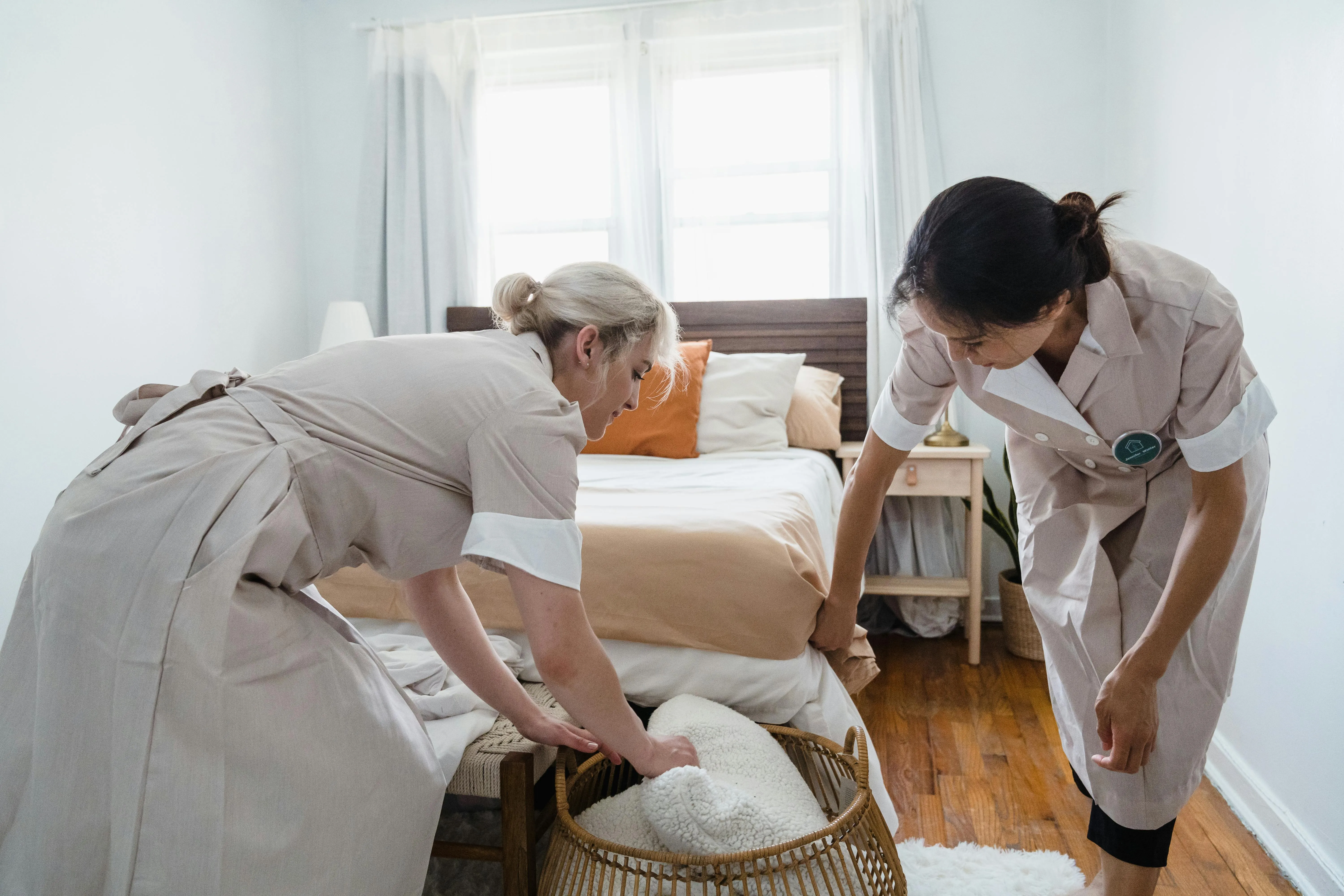
Bedding, mattresses, vacuum cleaners, mini-bar restocking, ironing, supply trolleys. A typical attendant handles the equivalent of significant cumulative loads daily. The Manual Handling Operations Regulations 1992 require the employer to avoid hazardous handling, assess where avoidance is not possible, and reduce risk to the lowest reasonably practicable level.
The hotel housekeeping reality is that room-turn pace does not always allow time to do it the safe way. Picture a queen mattress flip done solo because the brand standard requires a specific bed setup and the room turns over the same day. The attendant has been trained on manual handling. The attendant knows the safe technique. The attendant is also working to a 14-room day with a 30-minute turn target on a Tuesday. The unsafe technique is the faster one. The training does not change the schedule.
Manual handling housekeeping risk lives at the intersection of training and pace. A risk assessment that names the load and the technique without addressing the pace is half the answer. We see this pattern in branded hotel groups where the manual handling training is well-resourced and the operational pacing has not been re-engineered to allow it.
Reality 2: COSHH on the Cart
Every housekeeping cart carries cleaning chemicals: bathroom cleaner, disinfectant, glass cleaner, polish, descaler, toilet cleaner. The COSHH Regulations 2002 require the employer to assess exposure, control it, and provide information and PPE. The COSHH register should cover every product, the safety data sheet should be accessible, and the PPE for each product should be specified.
In hotels we find chemicals decanted into unlabelled bottles, COSHH registers that do not reflect the products in current use, and PPE worn inconsistently. One pattern shows up in branded hotel groups: the COSHH register is written for the corporate cleaning specification and the cart carries products from the local cash-and-carry because the attendant prefers them or the supply chain ran short. The register is technically up to date for the products it covers. The cart is not.
The fix is a COSHH register maintained against the products actually in use, refreshed when the supply chain changes, and verified at site level, not at head office level. Few hotels run it that way.
Manual handling housekeeping risk lives at the intersection of training and pace. A risk assessment that names the load and the technique without addressing the pace is half the answer.
Is your housekeeping manual handling risk assessment addressing the pace, or just the load?
Book a Confidential BriefingReality 3: Lone Working in Occupied Rooms
The hotel housekeeping attendant works alone in a guest's space. The guest may be present, even when do-not-disturb has been removed. The room may be in a state the attendant did not expect. Lone working risk includes intoxicated guests, unwell guests, unwanted contact, and panic situations.
The lone working procedure should define check-in cadence, panic alarm provision, and escalation route. Most hotels rely on a verbal policy. We have walked housekeeping shifts and seen the lone working procedure described as "use the radio if you need to" with the radio in a charging dock at the housekeeping office two floors away. The HSE expects employers to assess lone working risk, provide a means of communication or check-in, and define an escalation route. Lone working housekeeping in hotels is the area where the gap between the policy on paper and the policy in practice is widest.
The structural answer is a lone working procedure with a check-in cadence (radio every 30 minutes, app-based check-in by room, or a buddy pairing on each floor), a panic provision the attendant carries on their person, and a documented response route that has been tested. The verbal policy does not survive the first incident.
Reality 4: Sharps and Biohazard from Guest Bins
The risk that goes unrecorded most often. Used needles in bins from insulin pens or recreational drug paraphernalia. Used menstrual products. Contaminated tissues. Unidentified bodily fluids on bedding. The sharps protocol should be written, trained, and equipped. Sharps containers should be on every cart.
The reality in many hotels is that the protocol is verbal, sharps containers are at one location near the housekeeping office, and the attendant is told to use gloves and be careful. RIDDOR 2013 requires reportable injuries from sharps to be reported, and the absence of reportable sharps incidents is sometimes interpreted as the absence of risk. It usually means the protocol is being worked around informally.
The structural answer is sharps containers on every cart, biohazard bags as standard kit, and a documented escalation route when an attendant finds something they did not expect. The room attendant safety position has to include the moments when a room contains something it wasn't supposed to.
Reality 5: Slip Risk in Wet Bathroom Service
Bathroom turn includes wet surfaces, recently cleaned tiles, hair on shower floors, and water tracked across the corridor by a mop. Slip injuries are the second-largest housekeeping injury category after manual handling. The control regime covers footwear policy, drying time before next room, and wet-floor signage in corridors.
In practice, the footwear policy often is not enforced and the drying time is not built into the room-turn target. We have walked housekeeping shifts in hotels where attendants were wearing trainers from home because the brand-specified footwear was uncomfortable and the housekeeping office did not stock replacements in their size. The HSE slip and trip data is consistent across hospitality, and the hotel housekeeping subset is the largest contributor.
Reality 6: Repetitive Strain and the Long-Term Health Picture
Cleaning, bed-making, vacuuming, scrubbing, reaching, bending. Cumulative musculoskeletal strain is a long-term H&S issue that does not surface in RIDDOR but does surface in absenteeism, attrition, and occupational health claims. The H&S programme should include musculoskeletal risk assessment and rotation. Few hotel programmes do.
The HSE management standards on workplace welfare cover psychological and physical wellbeing as part of the risk assessment duty. Housekeeping is the department where the cumulative physical demand is highest and the rotation between tasks is often least developed. The fix is task rotation built into the shift pattern, supported by occupational health screening and an attrition data set that distinguishes between role-fit issues and physical-load issues. The pattern is invisible at quarterly intervals and clear over years. The same compounding issue across the wider H&S picture is covered in our broader piece on health and safety audits in hospitality.
Cumulative musculoskeletal strain is a long-term H&S issue that does not surface in RIDDOR but does surface in absenteeism, attrition, and occupational health claims. The H&S programme should include musculoskeletal risk assessment and rotation. Few hotel programmes do.

Does your H&S programme include musculoskeletal risk assessment for housekeeping?
Book a Confidential BriefingWhat Good Looks Like: Housekeeping H&S as a First-Class Department
A working housekeeping H&S programme has three layers.
Layer One: Housekeeping-Specific Risk Assessment
The first layer is a housekeeping-specific risk assessment that reflects the actual department, not the generic hospitality H&S template. Manual handling assessed against the actual loads and the actual pace. COSHH assessed against the products actually in use at site level. Lone working assessed against the building, the staffing model, and the response capacity. Sharps assessed against the actual incident pattern. Slips assessed against the footwear and the bathroom turn protocol. Musculoskeletal risk assessed against the rotation pattern.
Layer Two: Operational Housekeeping H&S Regime
The second layer is an operational housekeeping H&S regime with daily, weekly, and monthly checks built into the room-turn workflow. Daily PPE check at shift start. Weekly cart audit including sharps containers and chemicals. Monthly review of the lone working check-in pattern. Quarterly review of the risk assessment against incident data.
Layer Three: Estate-Level Independent Operational Review
The third layer is an estate-level independent operational review that walks housekeeping shifts at properties, not just kitchens and leisure. The same multi-property pattern shows up in hotel food safety and hotel pool safety compliance: the audit programme is consistent at the obvious areas and thins as it moves toward the less-walked departments. This is where our health and safety assurance work sits across hotel estates.
When to Commission an Independent Housekeeping H&S Review
The trigger points show up in patterns. A spike in RIDDOR submissions from housekeeping. Significant attrition in the department, particularly within the first six months of a hire. Post-acquisition where workforce data is unclear. Ahead of an insurer renewal. When the existing H&S programme has not specifically addressed housekeeping in 18 months. When the brand standard has changed in ways that affect room-turn pace or product specification.
Operators in our hotel sector practice tend to commission the housekeeping review when one of these triggers surfaces. The stronger position is the structured cycle that runs ahead of the trigger, not behind it.
If your hotel estate runs an H&S programme that scores the kitchen and the leisure facility at length and housekeeping at one paragraph, an independent housekeeping operational review can show you what the audit has not been reaching.